You start with a radio.
You end with an autonomous fleet.
A dispatch management game spanning 50 years of urban mobility. Same city, same pressure — assign the right taxi, track the revenue, end the shift. Then try to do better tomorrow.
Whether it's 1974 or 2041, the core problem never changes. A request appears. You have seconds. The wrong call costs you — in revenue, in wait time, in a customer who doesn't come back. The tools evolve. The pressure doesn't.
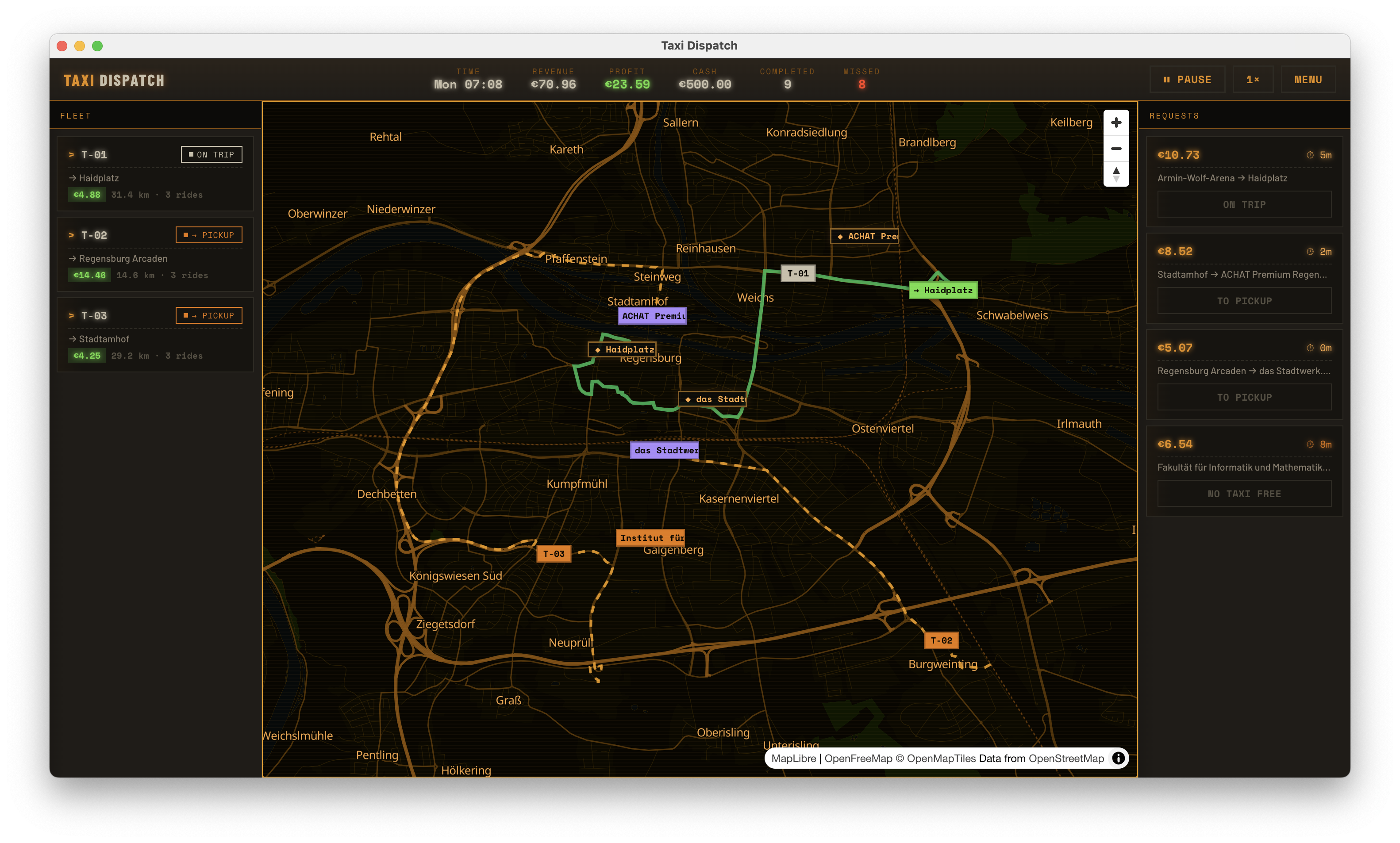
An orange marker lands on the map. You see the pickup, the destination, the estimated fare — and a wait timer counting down before the passenger gives up.
Click the request, then an idle taxi. Hit assign. Closest isn't always right — think about where demand is building and what you're giving up elsewhere.
Your taxi follows real Regensburg streets to the pickup, then to the destination. Watch the route unfold live on the map as the clock ticks.
Fare credited. Net profit updates — revenue minus fuel and driver costs. Missed requests cost you reputation. Rinse and repeat. It's going to get busier.
Regensburg on real OSM tiles. 60+ curated POIs. OSRM street routes. Three taxis on the map right now.
Playable prototype · Regensburg, Germany · 60+ curated POIs · OSRM street routes · 3 taxis
These are the pillars we're building toward the early access MVP — partly implemented in the prototype today, the rest in active design. Together they're what turns "click a taxi" into a dispatch you have to actually think about.
Passengers grade you 1–5 stars based on how fast you assigned a taxi relative to their patience. Stars feed a persistent 0–100 reputation score that survives between shifts and pushes demand up or down.
Every kilometer burns fuel. Every busy hour pays the driver. The HUD shows live net profit — fares minus costs — and cash carries forward between shifts as the bankroll for upgrades.
Shifts run a 12-hour Dayshift (06:00–18:00) and the weekday matters. Monday nights are quiet, Friday and Saturday push the fleet to its limit. Seasonal events stack on top later.
Twelve clean pickups unlocks a second radio channel and a €250 grant. Reputation past 75 opens a fourth taxi. Story beats arrive as pause-and-narrative moments tied to what you've actually done.
After the radio milestone, every taxi gets a "next ride" slot. Queue a request to a busy car and it auto-promotes the moment the current trip drops off. Time it wrong and the queued passenger still walks.
Rare long-distance requests to MUC or NUE pay flat-rate fares that cover the empty return leg. Big money — but the car is off your board for the rest of the rush. Take the gamble or hold the city.
The interface transforms. The pressure doesn't. Each technological era rewrites what it means to run a dispatch.
Manual everything. Drivers call in. You juggle requests on paper while the amber CRT glows in a dark room. This is where the game starts.
Mobile phones arrive. Bookings multiply. Card payments, new customer expectations, and a busier dispatch board — the job that fit in your head now needs a system.
The app appears. Demand surges. Platform competitors threaten. Automation starts to creep in.
No drivers. Lower running costs, massive upfront investment. The dispatch problem isn't simpler — it's just completely different.
Taxi Dispatch is a playable prototype — Regensburg in the 1970s, real streets, real routes. Assign rides, earn revenue, end the shift, try to do better. Drop your email and we'll reach out when early access opens.
Join the early access listWe will only email you about playtests and launch updates.